[language-switcher]

Dijital eğlence arayanların adresi bettilt siteleri oluyor.
Her zaman yenilikçi adımlar atan bettilt sektörde fark yaratıyor.
Adres doğrulaması yapmak için bettilt kullanmak şart.
Adres engellemelerini aşmak için bettilt kritik önem taşıyor.
Global e-spor bahis pazarının büyüme oranı yılda %12’dir; bettilt giriş bu segmentte aktif olarak yer almaktadır.
Bahis sektöründeki yoğun trafik nedeniyle Türkiye, Avrupa’nın önde gelen online pazarlarından biri olmuştur, bettilt giriş bu pazarda aktiftir.
DATE
08. 10. 2026 - 09. 10. 2026
INSTITUTION
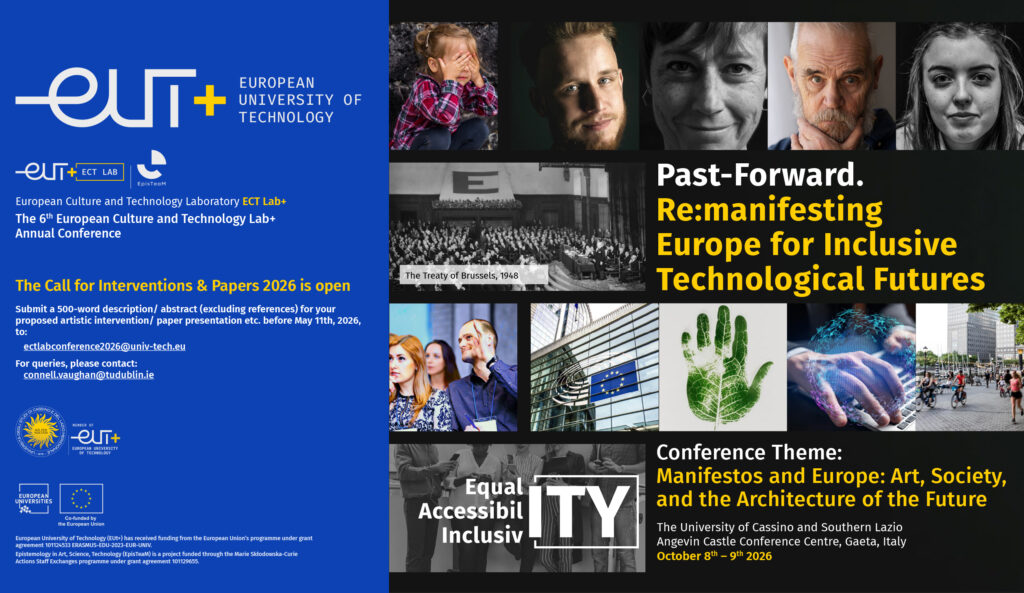
Past-Forward. Re:manifesting Europe for Inclusive Technological Futures
Deadline Extended to May 11th 2026
Manifestos and Europe: Art, Society, and the Architecture of the Future
“
“[…] the people of Europe [have] a common destiny […]” (Altiero Spinelli and Ernesto Rossi “For a Free and United Europe. A draft manifesto,” 1941)
The 6th Annual Conference organized by the European Culture and Technology Laboratory (ECT Lab+) hosted by the University of Cassino and Southern Lazio at the historic Angevin Castle in Gaeta will bring together experts from the Arts, Humanities, Social Sciences, Technology, and other fields to explore ways of enquiry that enrich (non-)positivist ways of knowing as well as post-structuralist critiques.
In the darkest hour of European history, a small group of determined intellectuals, confined for their beliefs on the Tyrrhenian island of Ventotene, just off the coast from Gaeta, penned a visionary text that would shape Europe’s future: For a Free and United Europe. A Draft Manifesto. The Ventotene Manifesto envisioned Europe as a project founded on cooperation, democracy, social justice, and the rejection of exclusionary sovereignties.
Inspired by the transdisciplinary practice of the manifesto, from art and design to political economy and technology, this conference proposes returning to the founding values and visions of Europe’s future. In a time marked by rapid technological transformation and planetary uncertainty, the manifesto’s spirit of resistance and democratic imagination invites us to rethink the relationship between technological innovation and social sustainability, in its multiple forms (digital, infrastructural, industrial, ecological, and cultural).
Open Call
The Manifesto has long served as a technology for cultural and political transformation. From the avant-garde declarations of the early 20th century to the radical political visions of wartime Europe. This conference will explore the manifold roles of manifestos in shaping European identity, aesthetics, design and political economy. Under these premises, we invite papers, panels, performances, workshops, seminars, poster presentations, artistic submissions, artist talks, installations, interventions etc. that address manifestos and Europe in the 21st century.
The open call is directed to scholars, philosophers, scientists, artists, designers, and creative practitioners. We welcome submissions from early career researchers and artists. From the Ventotene manifesto to human-centred technological futures, the conference will consider proposals including but not limited to:
The reinvigoration of the Manifesto’s spirit of cooperation, tolerance, culture of respect and acceptance of diversity at all levels (political, societal and cultural).
The challenge of a safe and democratic environment in a context dominated by a non-human centred technology.
Designing European pathways to technological inclusion and equitable distribution.
The role of institutions and policymakers to ensure a widespread enjoyment of the technological benefits.
Social sustainability, global well-being, and the impact of AI on job satisfaction and the cultural life.
The intersection of artistic, design, political, economic and technological manifestos and visions of Europe.
The legacy of the Ventotene Manifesto.
The manifesto as a tool of resistance and renewal in the digital age.
The aesthetics of emergency: style, rhetoric, and form in manifesto writing.
Manifestos as European cultural heritage and manifestos relating to European cultural heritage.
Digital manifestos and algorithmic publics.
The relationship of engineering and technological design to manifesto practices and European values.
Artistic interventions that reimagine manifesto traditions and address technological concerns.
Collaborative projects that merge technical rationality with aesthetic experimentation.
The role of European institutions, university alliances, transdisciplinary laboratories and research centres to act as mediators between technological innovation and societal well-being.
The possibility of the manifesto in terms of planetary thinking.
Reflections on productivity gains wrought by technological advances and work life balance.
Beaconing along the Tyrrhenian coast and overlooking the sea routes connecting Gaeta to Ventotene and the Pontine Archipelago, the Castle of Gaeta, is a conference venue of exceptional historical significance. Founded in the thirteenth century as a strategic stronghold controlling access to the Kingdom of Sicily, it became a key military and political centre through Angevin, Aragonese, Spanish and Bourbon rule. Its formidable fortifications witnessed decisive sieges during the Napoleonic wars and the Italian unification, symbolising both resistance and state power. From the eighteenth century onwards, the castle assumed a new role as a prison, a function it retained until 1990, extending its relevance into contemporary history.
Please submit a 500-word description/ abstract (excluding references) for your proposed artistic intervention/ paper presentation etc. before May 11th, 2026 (Extended Deadline).
Please use the PDF-file format for submission and render your text completely anonymous (metadata included) to allow for blind refereeing. Please send your title and abstract to: [email protected]
An edited volume of conference proceedings will be published in 2027. Previous proceedings can be found here, here, here and here.
For queries, please contact [email protected]
This project has received funding from MSCA SE programme under grant agreement No.101129655
Download Call For Interventions and Papers here.